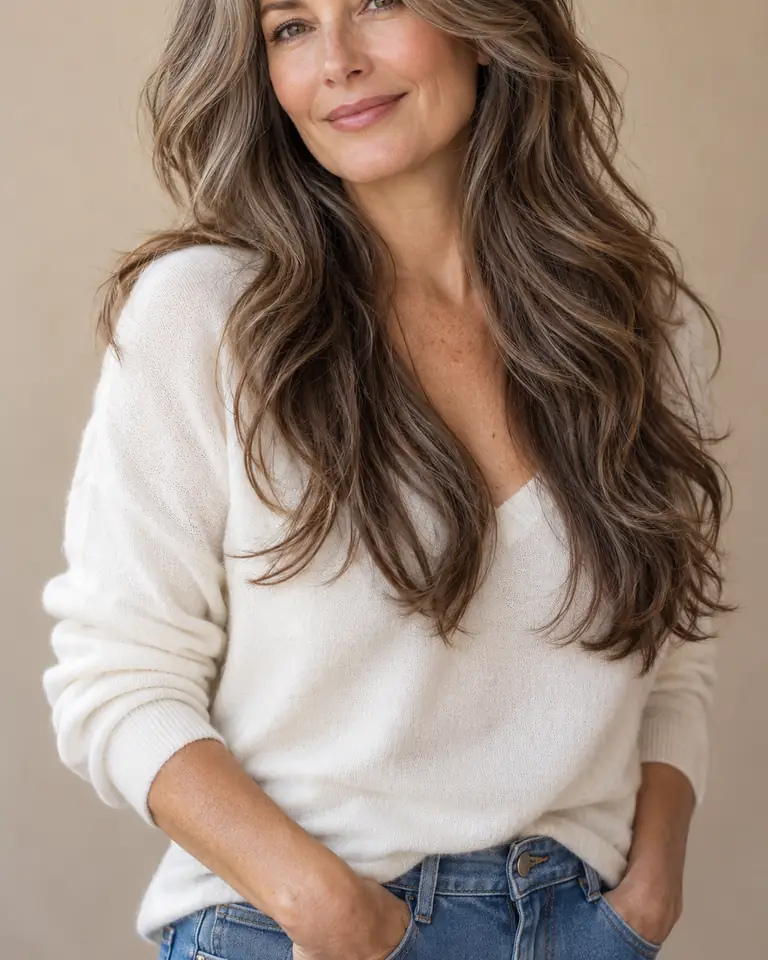
Long hair after 50 can look healthy and modern when the shape supports the density you have now. The goal is not endless layers; it is placing movement where it adds lift while protecting the strength of the ends.
- Start with your current texture, density, condition, and color history.
- Choose the maintenance rhythm you can realistically keep.
- Save references that show the front, side, and back whenever possible.
- Ask your stylist how the idea should be adapted rather than copied exactly.
01
Long butterfly layers
Shorter face layers open away from the cheekbones while the back keeps its length. The shape gives a blowout movement without thinning every section.
Ask for: long butterfly layers with the shortest piece below the cheekbone and a full back perimeter.
02
One-length glossy hair
A strong baseline makes long fine hair look denser. Subtle polishing rather than heavy layering keeps the ends substantial.
Ask for: a clean one-length perimeter with only minimal face framing.
03
Soft curtain fringe and lengths
A long curtain fringe introduces movement around the face without sacrificing overall length. It can blend back easily as it grows.
Ask for: a long curtain fringe that opens at the cheekbones and connects into the lengths.
04
Long natural waves
Long layers placed below the chin encourage wave formation while preventing the ends from becoming sparse.
Ask for: long wave-supporting layers with weight preserved through the bottom third.
05
Silver blended layers
Dimensional silver, gray, and brunette tones make long layers look luminous. A gloss helps the different tones read as intentional.
Ask for: long layers with a blended silver transition and no harsh demarcation line.
06
Long curly shape
Rounded long layers balance curl volume from crown to ends. The cut should be assessed in the texture you wear most often.
Ask for: a curl-aware long shape with crown support and a strong lower outline.
07
Low polished ponytail
A low ponytail with soft crown lift is elegant and gentle on long hair. Wrap the base and leave the tail fluid rather than over-smoothed.
Ask for: a comfortable low base, slight crown lift, and a concealed elastic.
08
Half-up soft twist
Twisting two side sections into a small half-up style keeps hair off the face while showing the length.
Ask for: two soft side twists secured without flattening crown volume.
09
Long side-swept layers
A deep side part and diagonal layers create lift and movement around the face. Keep the opposite side substantial for balance.
Ask for: long diagonal face framing designed around a preferred side part.
10
Loose brushed curls
Large brushed curls make long hair look soft and full without tight definition. Set the ends and mid-lengths while keeping the crown touchable.
Ask for: large curls brushed into one soft shape with flexible hold.
11
Long braid with volume
A loose three-strand braid protects the lengths and feels modern when gently expanded. Keep the hairline comfortable and the finish controlled.
Ask for: a low-volume crown leading into a softly expanded braid with secured ends.
FAQ
Questions before you book
How should I choose between these 11 ideas?
Begin with the idea closest to your current length, texture, and color level. Then compare the maintenance notes and ask a professional which details can be adapted without compromising hair health.
Should I bring reference photos to the salon?
Yes. Bring two or three references and explain what you like in each one. Include at least one image with a texture and density similar to yours.
How do I keep the result looking fresh?
Use the care routine recommended for the service, protect hair from unnecessary heat, and schedule maintenance according to the shape or color rather than waiting for it to feel unmanageable.
Our editorial approach
Inspiration with practical context
Timeless Tresses pairs visual ideas with texture, upkeep, and salon-language notes. A qualified stylist or colorist should assess your hair in person before a major chemical or structural change.